About 3SI-CONTROL
- Home
- About 3SI-CONTROL
Taenia solium, Schistosoma and STH
The Challenge and Our Approach
Neglected tropical diseases like Taenia solium (causing neurocysticercosis), soil-transmitted helminths (STH), and schistosomiasis (SCH) affect the world’s poorest communities, causing chronic illness, malnutrition, and neurological disorders. While mass drug administration (MDA) has improved STH and SCH control, efforts for control of Taenia solium remain fragmented/absent.
The 3SI-CONTROL project supports the WHO’s call for integrated approaches. We evaluate a novel fixed-dose combination of albendazole and ivermectin and assess its safety when co-administered with praziquantel, especially in populations at risk of hidden neurocysticercosis.
By combining treatment innovation with community engagement and implementation research, we aim to create sustainable, locally adapted strategies to reduce the burden of these diseases and advance global health equity.
The Parasites We Target
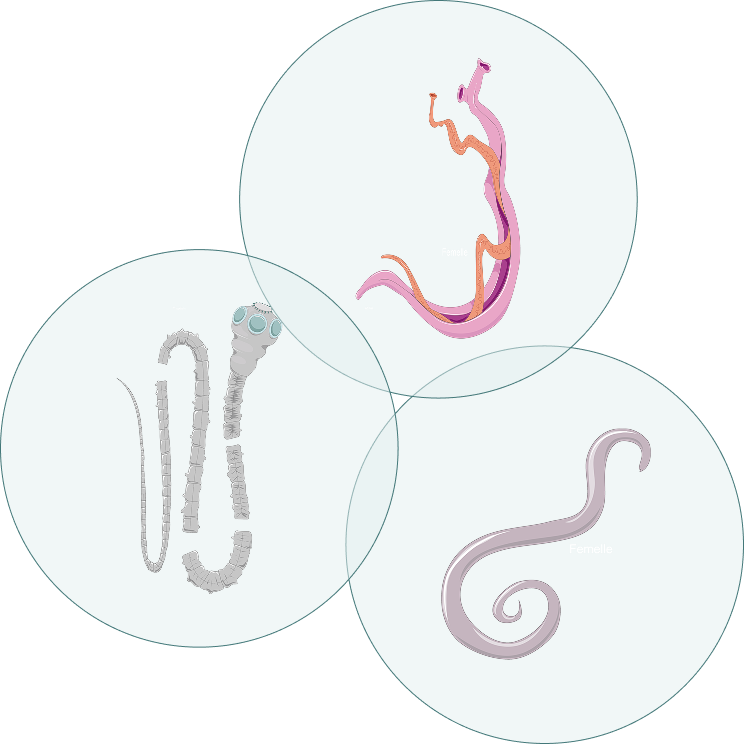
The Three Parasites We’re Fighting
Taenia solium cysticercosis/taeniasis, soil-transmitted helminthiasis (STH), and schistosomiasis (SCH) are neglected tropical diseases that disproportionately affect the world’s poorest communities. If left untreated, STH and SCH may result in long-term chronic morbidity including anaemia and iron-deficiency, malnutrition and impaired child growth and cognition. In addition, SCH may cause liver and urogenital tissue damage, while T. solium-related morbidity is strongly associated with neurocysticercosis (NCC), a major cause of epilepsy and various neurological disorders within endemic regions.
Over 200 million people live with SCH, and STH affects 1.5 billion worldwide, with sub-Saharan Africa carrying much of this burden. Data on NCC in SSA, on the other hand, is scarce despite it being one of the leading preventable causes of epilepsy worldwide. Estimates suggest that worldwide 2.56-8.30 million individuals are currently affected by NCC, contributing to up to 30% of epilepsy cases in endemic areas.
About the Project
What is 3SI-CONTROL
The 3SI-CONTROL project focuses on improving the control of three major neglected tropical diseases (NTDs): Taenia solium cysticercosis/taeniasis, schistosomiasis (SCH), and soil-transmitted helminths (STH) in Zambia, Tanzania, and Mozambique.
Running from June 2025 to May 2029, the project is coordinated by Ghent University (Belgium) and brings together a strong consortium of partners:
- University of Zambia (Zambia)
- Institute for Global Health Barcelona – ISGlobal (Spain)
- Hospital Clinic de Barcelona (Spain) (affiliated entity)
- Fundação Manhiça (Mozambique)
- University of Dar es Salaam (Tanzania)
- Sokoine University of Agriculture (Tanzania)
The project is funded by the Global Health EDCTP3 Joint Undertaking under Horizon Europe.
Work Packages (WPs)
Our objectives
8 Work Packages
The activities in 3SI-CONTROL are structured into 8 interconnected work packages (WPs) tackling three important NTDs (T. solium cysticercosis/taeniasis, SCH and STH) in Zambia, Tanzania and Mozambique.
WP 1
Clinical Trial
Clinical trial to assess safety of FDC and co-administration of praziquantel.
WP 2
Monitoring Effectiveness
Monitor treatment effectiveness for Taenia solium, STH, and Schistosoma.
WP 3
Monitoring Effectiveness
Develop integrated MDA strategies for Taenia solium, STH & SCH.
WP 4
Modelling & Cost-Effectiveness
Model epidemiological impact and cost-effectiveness of MDA.
WP 7 & 8
Monitoring Effectiveness
Monitor treatment effectiveness for Taenia solium, STH, and Schistosoma.
Detailed Overview of Our Work Packages
WP1 – Clinical trial to assess the safety of FDC and PZQ co-administration
Lead beneficiary: University of Dar es Salaam
Work package 1 builds around a multicentric cluster randomised controlled trial aimed at evaluating the safety of mass drug co-administration of FDC and PZQ at the community level in Zambia and Tanzania.
WP2 – Effectiveness of the clinical trial against the three parasitic diseases
Lead beneficiary: University of Zambia
In WP2, the objective is to monitor the effectiveness of the co-administration of FDC and PZQ on T. solium, STH and SCH prevalence. This will only be carried out in Zambia.
WP3 – Implementation Research
Lead beneficiary: Sokoine University of Agriculture
WP3 aims to develop country specific tailored implementation strategies for its integration with existing initiatives for STH and Schistosoma control. The strategies will include both the implementation of integrated control as well as the implementation of adverse event surveillance. This strategy will be developed, evaluated and optimised within the framework of the aforementioned clinical trial in Zambia, and will also be developed for Tanzania and Mozambique, with implementation research conducted in all three SSA countries
WP4 – Cost-effectiveness and modelling impact of the integrated MDA strategy
Lead beneficiary: ISGlobal
In WP4, we will conduct a thorough cost-effectiveness evaluation of the integrated administration of FDC and PZQ in contrast to existing single control programs for each disease. Leveraging data from the project, as well as retrospective data, we also aim to model the long-term impact (> 5 years) of prevalence reduction across various scenarios for STH, SCH and T. solium.
WP5 – Capacity Building
Lead beneficiary: Fundação Manhiça
WP5, is centered on building capacities for researchers and healthcare workers in SSA to further develop, design and execute large clinical trials independently, as well as increase capacity in research on NTDs and implementation sciences. To achieve this, the project will draw upon a structured capacity building framework which encompasses three interrelated dimensions: human resource devolopment, institutional capacity enhancement, and partnership and collaboration.
WP6, 7 & 8– Project support
The entire framework of the project is supported by the following three WPs: a WP dedicated to effective stakeholder management and dissemination of the project’s results to maximize adoption and sustainability (WP6), a WP focusing on project management and coordination (WP7), and a final WP responsible for scientific leadership to support effective integration of scientific activities (WP8)